5.6.5.3 Quantenkomplexität und Thermofeld-
Doppel Zustände
1. Quantenkomplexität
„Aktion A und Volumen B eines AdSd1 Wurmlochs sind als neue, interessante holografische Observablen aufgetaucht. Wegen des einfachen und universellen Charakters dieser Quantitäten scheint es sinnvoll anzunehmen, dass es eine natürliche Feld Dualität geben muss.
Wie .. in der jüngsten Literatur dargelegt, scheint „Rechnungskomplexität“ („computational complexity„) ℂ [vgl. auch 5.6.5.2, d.V.] ein geeigneter Kandidat zu sein, da sie insgesamt die gleichen Merkmale wie die Ziel Observablen hat. Diese Beziehung führte sowohl zu der ‚Komplexität=Volumen‚ (C=V) Hypothese [3] und jüngst auch zu der ‚Komplexität=Aktion„ (C=A) Hypothese [1,2].“1
Die holografische „Komplexität=Aktion“ (CA) Vermutung bezieht sich auf die Aktion einer bestimmten Bulk Region im Rahmen einer holografischen Theorie der Komplexität eines „Schaltkreises“ (circuits), die erforderlich ist, um einen korrespondierenden Grenzzustand (boundary state)2 zu erzeugen.
Genauer gesagt, im Kontext eines zweiseitigen AdS – Schwarzen Lochs wählt man zwei verschiedene Zeitscheiben – tL,tR, – auf den beiden Grenzflächen und definiert dann eine Wheeler-deWitt (WdW) Region (patch) – vgl Abb. 5.6.5.2, Abb. 1– die aus allen raumartigen Pfaden besteht, die diese beiden Zeitscheiben miteinander verbindet. Die Behauptung lautet dann, dass die Aktion der WdW Region dem rechten Grenzflächen Zustand beitR entspricht.
Die Wahl von tL erfolgt analog zu einem Referenz Zustand und daher leidet diese Definition unter der erwarteten Ambiguität. Offensichtlich ist die Definition links-rechts symmetrisch; man könnte daher auch annehmen, dass man die Komplexität des Grenzflächen Zustandes auf der Zeitscheibe tL definiert hat, wobei tR implizit einen Referenz Zustand wählt.
Diese C=A Vermutung und die ähnliche C=V Vermutung sind motiviert durch die Tatsache, dass diese beiden Quantitäten ein lineares Wachstumzeigen, lange nachdem das System thermalisiert ist. 3
2. Thermofeld Doppel Zustand
Eines ewiges Schwarzschild Schwarzes Loch im AdS Raum, i. e. ein (theoretisches) Schwarzes Loch, das schon immer existierte und immer da sein wird, ist dual zu 2 Kopien der konformen Quantenfeldtheorie, die in einem „Thermofeld Doppelzustand“ („thermofield double state“) präpariert ist.
Im Kontext der Holografie spielen Thermofeld Doppel Zustände („thermofield double“, TFD) eine besondere Rolle. Derartige Zustände werden durch die Verschränkung zweier Kopien einer konformen Feldtheorie (CFT) gebildet und zwar derart, dass durch Ausspuren der einen Kopie die thermische Dichtematrix der anderen Kopie – mit inverser Temperatur β – entsteht.
Die rechte und die linke Seite der Geometrie des Schwarzen Lochs, das dual zu dem TDF Zustand ist, ist durch ein Wurmloch i.e. eine Einstein Rosen Brücke (ERB) miteinander verbunden, deren Volumen einen Zeitraum lang anwächst, der exponential ist hinsichtlich der Zahl der Freiheitsgrade der Grenzflächen Theorien (Kopien der CFTs).
Diese Zeitdauer ist viel länger als andere typische Zeiträumen in der Holografie. Dies impliziert, dass die Verschränkungsenergie Konformer Feldtheorien(CFTs, ) nicht ausreicht, um die Dynamik hinter dem Horizont(des Schwarzen Lochs) abzudecken und dass es daher noch eine andere Quantität in der dualen Feldtheoriegeben muss, welche die zeitlich spätere Entwicklung des Inneren des Wurmlochs enkodiert. Man hat vorgeschlagen, dass es sich bei dieser Quantität um die Quanten tt des Quantenzustandes (quantum computational complexity) der Grenzfläche (der CFTs) handelt.4
Der Begriff der „holografischen Komplexität“ (auch „Teilregionen Komplexität“) „bezieht sich zum einen auf einen „Komplexität-Volumen“ – und zum anderen auf den „Aktions Komplexität“ – Zusammenhang… „Rechenkomplexität“ referenziert die Berechnung gravitativer Wirkung in einer Wheeler-DE Witt Raumregion Null Hyperflächenund Null Kodimension-2 Verbindungen… 5
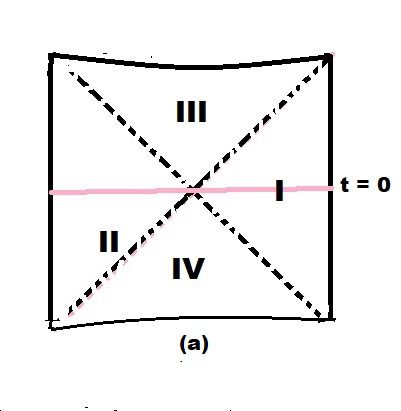
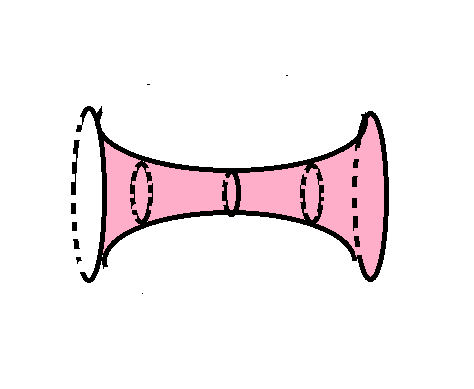
Abb. 1 Darstellung eines Einstein-Rosen (ER) Brücke in einem „maximal ausgedehnten AdS-Schwarzschild Schwarzen Loch„. 6„Maximale Ausdehnung“ bedeutet, dass die Ausdehnung einer Raumzeit endet, „weil sie entweder umgeben ist von einer asymptotischer Unendlichkeit – einem unendliches Volumen, in dem Trajektorien bis zu einer unendlichen Eigenlänge ausgedehnt werden können – oder von echten Krümmungssingularitäten [wie die Urknallsingularität oder Raumzeit – Singularitäten in Schwarzen Löchern], die nicht durch geeignete Koordinaten [- Systeme] ausgedehnt werden können. Geodäten [= kürzeste Verbindung zwischen zwei Punkten, bei gekrümmten Räumen Kurven) werden physikalisch begrenzt durch diese Singularitäten.7
Eine „maximal Ausdehnung“ einer Schwarzschild Geometrie (Schwarzes Loch) wird erreicht durch ein Koordinatensystem – die sogenannten Kruskal – Szekeres Koordinaten – durch die für die äußere Region r > 2m bzw. die innere Region r < 2m eine Ersetzung der Schwarzschild Koordinaten (t,r) durch die neue zeitartige Koordinate T und durch die neue raumartige KoordinateX erfolgt. Kruskal – Szekeres Koordinaten werden auch in der sogenanntewn „Lichtkegelform“ verwendet, die mit den Koordinaten U = T-X und V = T+X arbeitet.
In der maximal ausgedehnten Lösung treten zwei Singularitäten bei r=0 auf, eine für positives T und eine für negatives T.8 Die negative T Singualarität ist das zeitumgekehrte Schwarze Loch, auch als „Weißes Loch“ bezeichnet (vgl. 5.5.2.1).
Abb. 9 zeigt (a) ein konformes Penrose Diagramm für die Raumzeit eines maximal ausgedehnten AdS-Schwarzschild Schwarzen Lochs, mit den äußeren Regionen I und II und den inneren Regionen III und IV hinter dem gestrichelt dargestellten Horizont. Die untere bzw. obere wellenartige Linie stellt die Vergangenheits- bzw. Zukunftssingularität dar, während die horizontale rosa Linie die Zeitscheibe der Raumzeit zur Zeit t=0 bezeichnet. (b) Die räumliche Geometrie der t=0 Raumscheibe zeigt den Horizont als minimale Fläche – entsprechend der horizontalen rosa Linie in (a) – und teilt den Raum (i.e die Einstein-Rosen Brücke) in zwei Teile, jede eine asymptotische AdS Region. 9
- William Cottrell/Miguel Montero, Complexity is Simple!, Institute for Theoretical Physics Amsterdam, University of Amsterdam and Institute for Theoretical Physics and Center for Extreme Matter and Emergent Phenomena, Utrecht University, 3. Oktober 2017, pp. 1 seqq., [Digitale Ausgabe], URL: https://arxiv.org/abs/1710.01175
↩︎ - „Ein Boundary State (Randzustand) im Kontext von Quantencomputern und Quantenphysik bezeichnet spezifische Zustände, die an den Rändern eines Quantensystems auftreten, oft durch topologische Effekte geschützt. Sie sind entscheidend für die Entwicklung robuster Qubits und neuer Formen des Quantencomputings.“ ↩︎
- Ib. pp. 12 seqq. ↩︎
- Shira Chapman, Jens Eisert, Lucas Hackl, Michal P. Heller, Ro Jefferson, Hugo Marrochio and Robert C. Myers, Complexity and entanglement for thermofield double states , SciPost Phys. 6, 034 (2019) p. 3, [Digitale Ausgabe], URL: https://core.ac.uk/download/pdf/232002436.pdf ↩︎
- Hugo Cangussu Marrochio, Complexity in the AdS/CFTcorrespondence, A thesis presented to the University of Waterlooin fulllment of the thesis requirement for the degree of Doctor of Philosophy in Physics University of Waterloo, Waterloo: 2019, pp. 1 seqq., [Digitale Ausgabe], URL: https://uwspace.uwaterloo.ca/handle/10012/14880; „Der Begriff „null-codimension-2“ (oder codimension-2 null cut locus) bezieht sich in der allgemeinen Relativitätstheorie auf Teilmengen in der Raumzeit, die zwei Dimensionen weniger als die umgebende Raumzeit haben (z.B. eine 2D-Fläche in einer 4D-Raumzeit) und aus Lichtstrahlen (null Vektoren) bestehen. Diese Strukturen sind wichtig, um topologische Eigenschaften und Singularitäten zu untersuchen.“ Gregory J Gallooway and Eric Ling, „The codimension 2 null cut locus with applications to spacetime topology“, in: Journal of Mathematical Physics, 29. Mai 2022, Introduction, [Digitale Ausgabe], URL: chrome-extension://efaidnbmnnnibpcajpcglclefindmkaj/https://www.math.miami.edu/~galloway/papers/CutLocus.pdf ↩︎
- Abdulrahim Al Balushi, Robie A. Hennigar, Hari K. Kundurib und Robert B. Mann, Holographic complexity of rotating black holes, University of Waterloo, Waterloo, Memorial University of Newfoundland, St. John’s, New-foundland and Labrador, 2021, [Digitale Ausgabe], URL: https://arxiv.org/pdf/2010.11203.pdf ↩︎
- Lubos Motl, What is maximal analytic extension?, SlackExchange, Physics, [Digitale Ausgabe], URL: https://physics.stackexchange.com/questions/3998/what-is-a-maximal-analytic-extension ↩︎
- Mark Van Raamsdonk, Lectures on Gravity and Entanglement, University of British Columbia, Vancouver: 2016, [Digitale Ausgabe], p. 11, URL: https://arxiv.org/pdf/1609.00026v1.pdf ↩︎
- Ib., pp. 10-11 ↩︎
